Metadata Platforms: Use Cases, Components, and 7 Notable Solutions
What is a Metadata Platform?
A metadata platform is a centralized system that catalogs, manages, and analyzes "data about data," providing context, lineage, and structure for data assets across an organization. It enables data discovery, improves data governance, ensures data quality, and supports AI/ML operations by integrating metadata from various sources. Common examples include OpenMetadata, Collate, and DataHub.
Key components and functions:
- Data cataloging and discovery: Acts as a searchable inventory, making it easy for users to find and understand data assets.
- Data lineage: Maps how data is transformed, moved, and related across systems.
- Data governance and privacy: Helps manage data policies, security, and compliance with regulations like GDPR and CCPA.
- Data observability: Provides insights into data quality, pipeline functionality, and potential issues.
- Contextualization: Adds business definitions, ownership, and usage tags to technical data.
In this article:
- What Are Metadata Platforms Used For?
- Key Components and Functions of Metadata Platforms
- Types of Metadata Managed in a Metadata Platform
- Metadata Platforms vs. Related Solutions
- Notable Metadata Management Platforms
What Are Metadata Platforms Used For?
Metadata platforms are used to make data systems easier to understand, control, and operate. They centralize metadata such as lineage, ownership, and usage, which allows teams to track how data moves, who uses it, and how reliable it is. This supports governance, improves access to data, and reduces operational friction across analytics and engineering workflows.
Common use cases include:
- Regulatory compliance and auditing: Track data origin, ownership, and lineage to show how data is collected and used. Maintain change history to trace access, modifications, and downstream impact for audits.
- Analyst self-serve discovery: Provide a searchable catalog with dataset descriptions, ownership, and usage patterns. Surface trusted and frequently used assets to reduce duplication and support consistent analysis.
- Data incident response: Combine observability signals with lineage to detect failures and data issues. Identify affected datasets, downstream dependencies, and responsible owners to prioritize fixes.
- Cross-team data and reporting standardization: Centralize metric definitions, documentation, and governance policies. Link datasets and reports to shared definitions to ensure consistent calculations across teams.
- New hire onboarding and data literacy: Offer a single place to explore datasets, documentation, and ownership. Attach business context and usage guidance to help users understand and work with data correctly.
Key Components and Functions of Metadata Platforms
Data Cataloging and Discovery
Data cataloging is a core function of metadata platforms, enabling organizations to inventory data assets across disparate systems. The catalog acts as a searchable index, allowing users to find tables, datasets, reports, and other resources. Discovery tools use metadata to provide search, filtering, and tagging capabilities. This reduces time spent locating datasets in large, complex environments.
Beyond basic search, cataloging and discovery features often include automated metadata ingestion and enrichment. Platforms may use crawlers or connectors to extract metadata from various sources, keeping the catalog up to date. Enrichment can include adding business context, data classifications, and user-generated tags or annotations. These capabilities support self-service analytics and data literacy.
Data Lineage
Data lineage tracks the origin, movement, and transformation of data as it flows through systems. Metadata platforms visualize these relationships, mapping how data moves from source to destination and what transformations occur along the way. This visibility supports troubleshooting, impact analysis, and trust in analytics outputs, as users can trace results back to their sources.
Lineage also supports compliance and auditing. Organizations can demonstrate data provenance, satisfy regulatory requirements, and assess the impact of changes to upstream systems. Automated lineage tracking reduces manual effort and errors, while visualizations help technical and business users understand dependencies and data flow.
Data Governance and Privacy
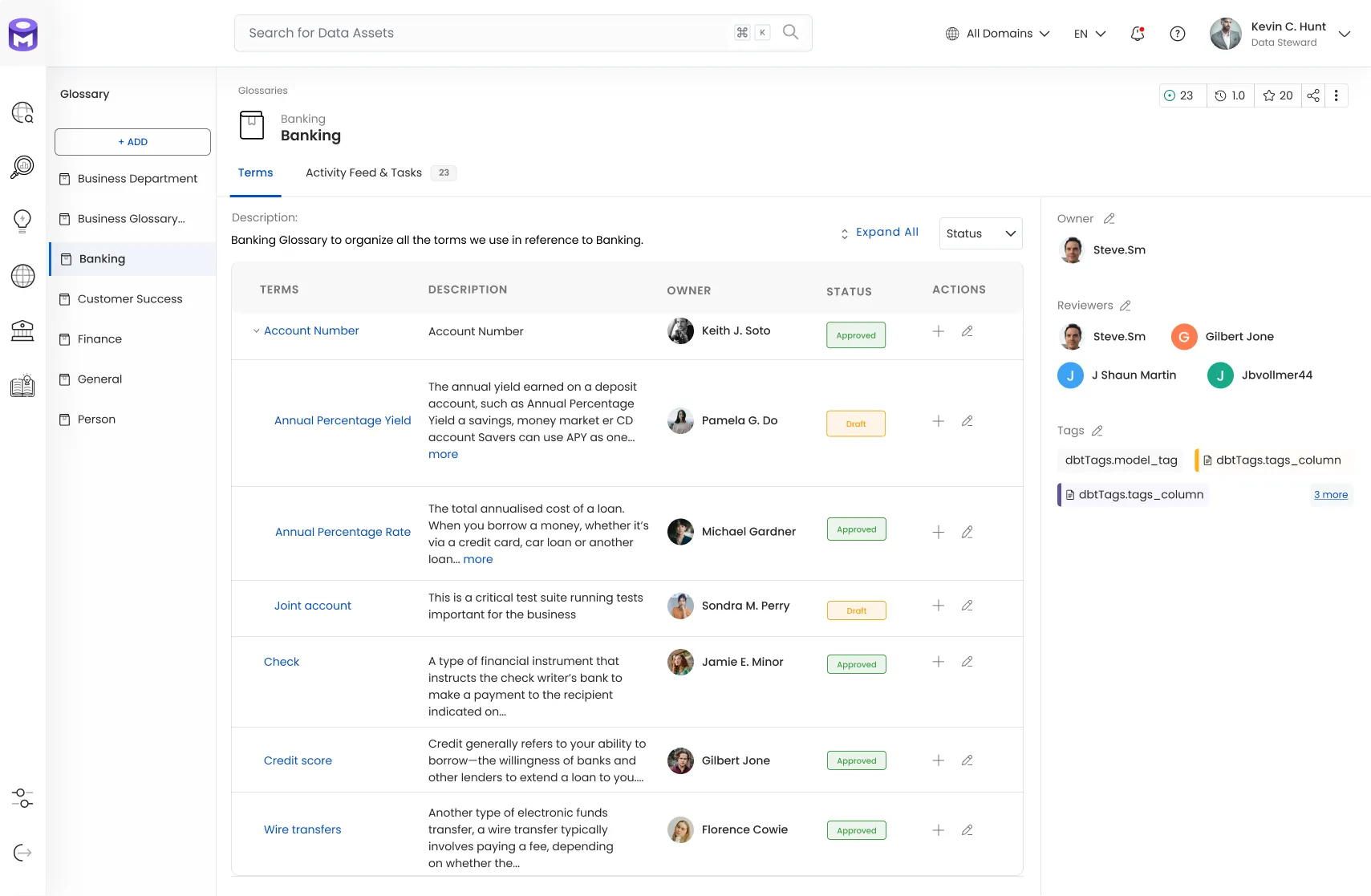
Data governance in metadata platforms involves enforcing policies for data quality, access, and usage. Platforms provide tools for defining data ownership, stewardship, and approval workflows, ensuring that data assets are managed responsibly. Metadata platforms centralize governance artifacts, such as data dictionaries, policies, and standards, making them accessible across the organization.
Privacy features help manage sensitive data by tagging, classifying, and monitoring its use. Automated detection of personally identifiable information, PII, or other regulated data types helps organizations comply with laws like GDPR or HIPAA. Governance and privacy controls reduce risk and prevent unauthorized access.
Data Observability and Quality
Data observability focuses on monitoring the health and reliability of data pipelines and datasets. Metadata platforms collect signals such as schema changes, pipeline failures, data freshness, and volume anomalies. These signals help teams detect issues early and understand when data may no longer be trustworthy.
Quality management is closely tied to observability. Platforms track metrics like completeness, accuracy, and consistency, often through automated tests or validation rules. When quality checks fail, alerts can notify data engineers or stewards so they can investigate the problem.
Because observability is built on metadata, platforms can also provide context around issues. For example, lineage information shows which downstream dashboards or models may be affected by a failed pipeline or corrupted dataset. This allows teams to assess impact and resolve problems while maintaining trust in data systems.
Contextualization
Contextualization enhances metadata with business-relevant information. This includes linking data assets to business processes, KPIs, or organizational objectives, making metadata more meaningful to nontechnical users. It enables users to interpret data based on its purpose, usage, and impact.
Platforms support contextualization by integrating with business glossaries, workflow tools, and collaboration platforms. They allow users to add descriptions, usage notes, or links to documentation. By connecting technical and business metadata, these platforms support shared understanding and informed decision-making.
Types of Metadata Managed in a Metadata Platform
Technical Metadata
Technical metadata describes the structure and storage of data assets. This includes schema definitions, data types, table relationships, indexing information, and system configurations. Technical metadata is automatically extracted from databases, data warehouses, and other sources, forming the basis of cataloging, lineage, and impact analysis features.
It may also cover pipeline configurations, transformation logic, and system dependencies. Maintaining accurate technical metadata supports operations, troubleshooting, and system migrations. It helps teams understand how data is stored, processed, and integrated.
Business Metadata
Business metadata provides context that makes data meaningful to end users. It includes business definitions, descriptions, glossary terms, data classifications, and ownership information. Business metadata connects raw data to its practical use, enabling consistent interpretation aligned with business objectives.
Managing business metadata improves data literacy and reduces confusion over definitions or metrics. Metadata platforms allow business users to contribute, validate, and share context, supporting compliance, reporting, and analytics initiatives.
Operational Metadata
Operational metadata tracks how data assets are used and maintained over time. This includes information about data refresh cycles, job schedules, processing times, error logs, and resource utilization. Operational metadata supports monitoring the health of data pipelines and identifying bottlenecks or failures.
By collecting and analyzing operational metadata, organizations can optimize performance and ensure data availability. Metadata platforms aggregate this information, providing dashboards and alerts that help data teams address issues.
Usage and Collaboration Metadata
Usage and collaboration metadata records how data assets are accessed, shared, and discussed within the organization. This includes user activity logs, access patterns, query histories, and annotations or comments. Tracking usage shows which data assets are most used and how they are used.
Collaboration features enable users to rate, review, or request changes to data assets. Usage metadata also supports governance by highlighting potential compliance issues or unauthorized access.
Metadata Platforms vs. Related Solutions
Metadata Platform vs. Data Platform
A metadata platform focuses on managing information about data rather than the data itself. It provides insight into where data comes from, how it is structured, who uses it, and how it moves through systems. In contrast, a data platform stores, processes, and serves data, such as databases, data lakes, or data warehouses. While data platforms power analytics and operational workloads, metadata platforms provide the context required to use data responsibly.
The distinction is important because organizations often conflate the two. Data platforms enable users to query and analyze data, but without metadata, users may not understand the data's meaning, quality, or relevance. Metadata platforms bridge this gap by offering search, lineage, governance, and quality features that overlay data platforms. The connection between both platforms is important for getting value from data while maintaining control and compliance.
Metadata Platform vs. Data Catalog
A data catalog is an application that provides an organized inventory of data assets, often featuring search, tagging, and basic lineage. It helps users discover and understand datasets by indexing metadata and exposing it through a user interface. Data catalogs typically focus on usability and collaboration, offering features like dataset descriptions, ownership attribution, and popularity rankings.
A metadata platform serves as a broader infrastructure layer. It supports cataloging and integrates with data systems to collect, store, and process metadata continuously. Metadata platforms provide APIs, support event-driven metadata updates, enable advanced lineage and impact analysis, and power governance and observability tools. In this sense, a data catalog is often a component or frontend of a metadata platform.
Notable Metadata Management Platforms
1. OpenMetadata
OpenMetadata is an open-source metadata platform and AI context layer that unifies technical and business metadata into a single, queryable knowledge graph. It uses a formal ontology and 130+ native connectors to address fragmentation across modern data stacks, giving teams one place to discover, govern, and trust their data.
Key features include:
- Open metadata standard: Defines a formal schema for tables, dashboards, ML models, lineage, and ownership, with W3C support including MCP, RDF, DCAT, DPROD, ODCS, and OpenLineage, so vendors and downstream tools implement a common ontology consistently.
- 130+ native connectors: Ships with connectors for databases, warehouses, BI tools, pipelines, and ML systems that ingest schema, lineage, ownership, and usage without custom code.
- Built-in quality and observability: Test suites, profilers, and incident workflows run alongside catalog functions, so quality and freshness are part of the same metadata graph.
- Column-level lineage: Captures lineage from SQL queries, ETL pipelines, and orchestrators at column-level granularity for impact analysis and debugging.
- Apache 2.0 licensed: Open source with an active community contributing connectors, schemas, and integrations across hundreds of platforms.
2. Collate

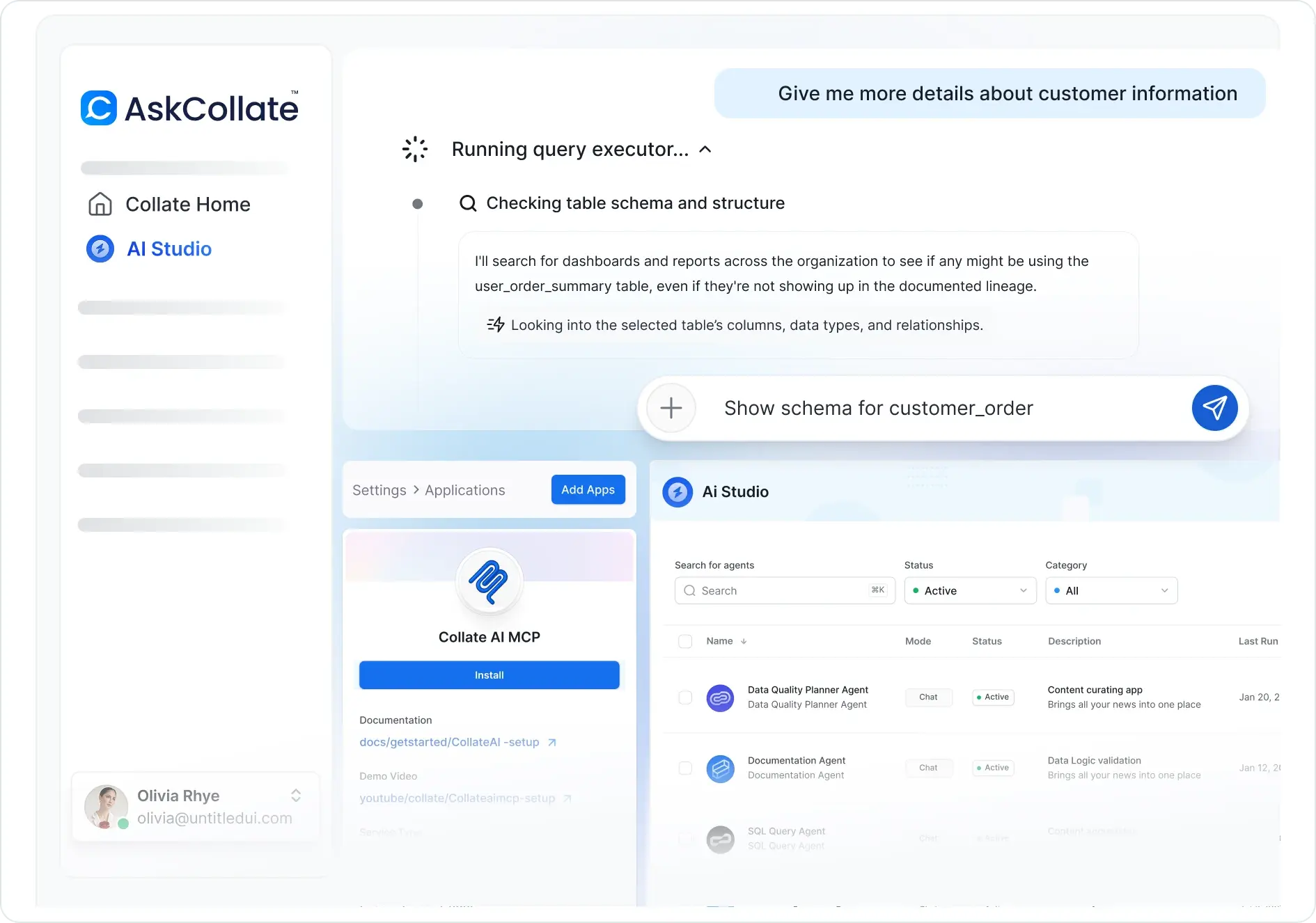
Collate is the AI for Data platform built on OpenMetadata. It extends the open metadata standard with managed deployment, enterprise governance, conversational AI, code & no code agents, and an AI native experience.
Key features include:
- Built on OpenMetadata: Inherits the open standard, 130+ connectors, and ontology of OpenMetadata while adding managed hosting, SSO, RBAC, and enterprise SLAs.
- Collate AI conversational interface: Users ask natural-language questions in web, Slack, or Teams and get governed, sourced answers grounded in their own data.
- Data marketplace and data products: Collate exposes trusted data products through a marketplace UI so business users self-serve, with integrated data access request workflows.
- AI agents ecosystem: Pre-built agents and a no-code AI Studio automate documentation, tiering, classification, and data quality at scale, with an AI SDK for custom AI applications.
- Memory, skills, and automations: Every approval, tag, and steward decision is captured as a permanent, attributable record that feeds back into governance reporting and agent learning.
3. Apache Atlas
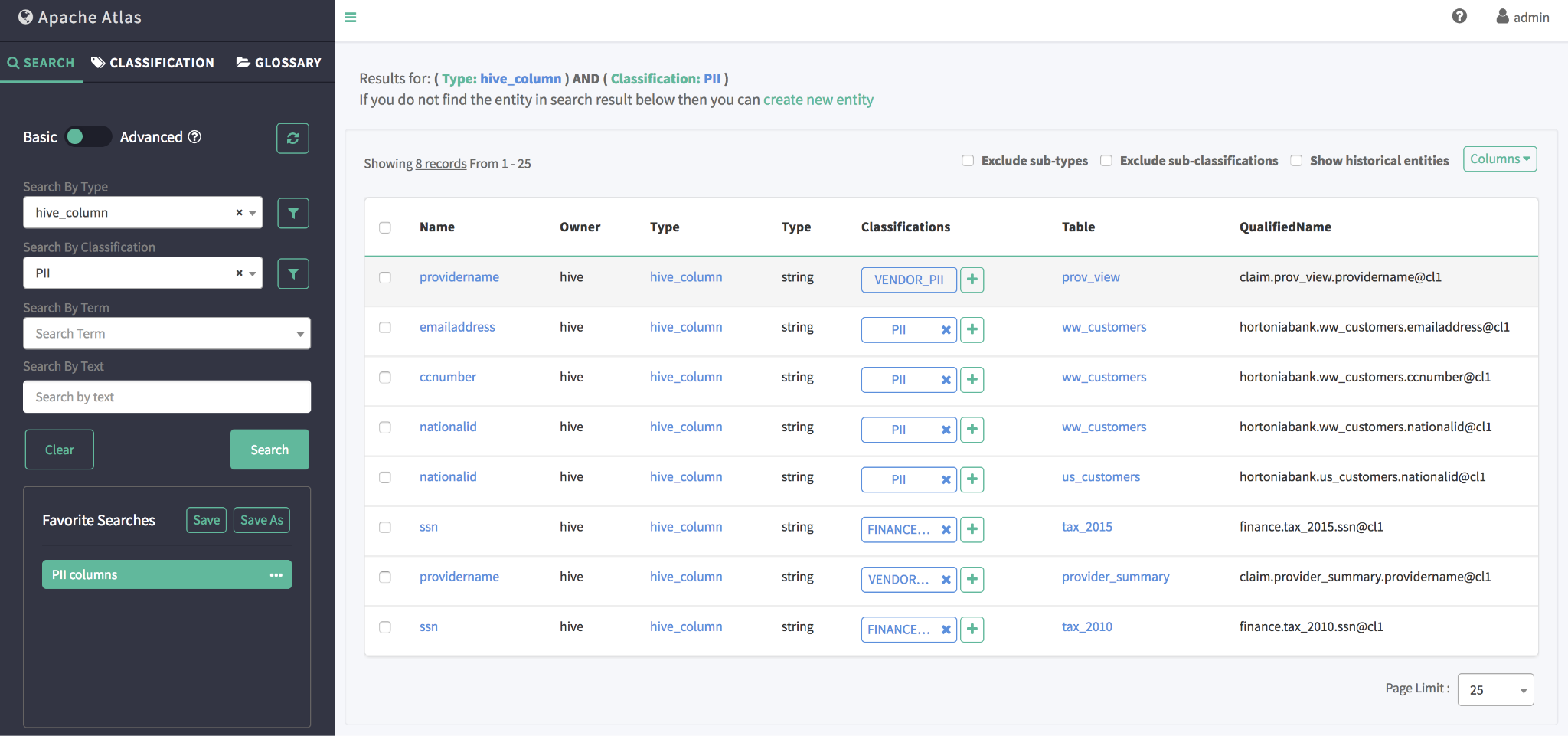
Apache Atlas is an open source metadata governance platform that helps organizations manage, classify, and track data assets across data ecosystems, particularly those built around Hadoop. It provides a framework for metadata management, allowing teams to catalog data assets, define governance rules, and monitor data movement. Atlas supports extensible metadata models and integrates with enterprise tools.
Key features include:
- Metadata types and entities: Provides predefined metadata types for Hadoop and other systems and allows custom types.
- Extensible metadata model: Supports primitive and complex attributes, object references, and inheritance between types.
- REST APIs for integration: Offers APIs to create, update, and query metadata types and entities.
- Dynamic data classification: Enables users to define classifications such as PII or sensitive data.
- Classification propagation through lineage: Propagates classifications as data moves through pipelines.
4. DataHub

DataHub is an open source metadata platform built around a scalable metadata graph. It connects datasets, pipelines, dashboards, and machine learning assets to capture relationships, lineage, and usage patterns. Organizations use DataHub to improve data discovery, ensure data reliability, and enforce governance policies. A managed SaaS version, DataHub Cloud, is also available.
Key features include:
- Metadata graph architecture: Represents relationships between datasets, pipelines, dashboards, and AI assets.
- Data discovery and personalization: Supports search, recommendations, and integrations with BI tools.
- Data lineage and provenance: Visualizes lineage at table, column, and job levels.
- Metadata enrichment and documentation: Enriches metadata using automation and AI-generated documentation.
- Data observability and quality monitoring: Tracks data freshness, schema changes, and quality checks.
5. Atlan Data Catalog

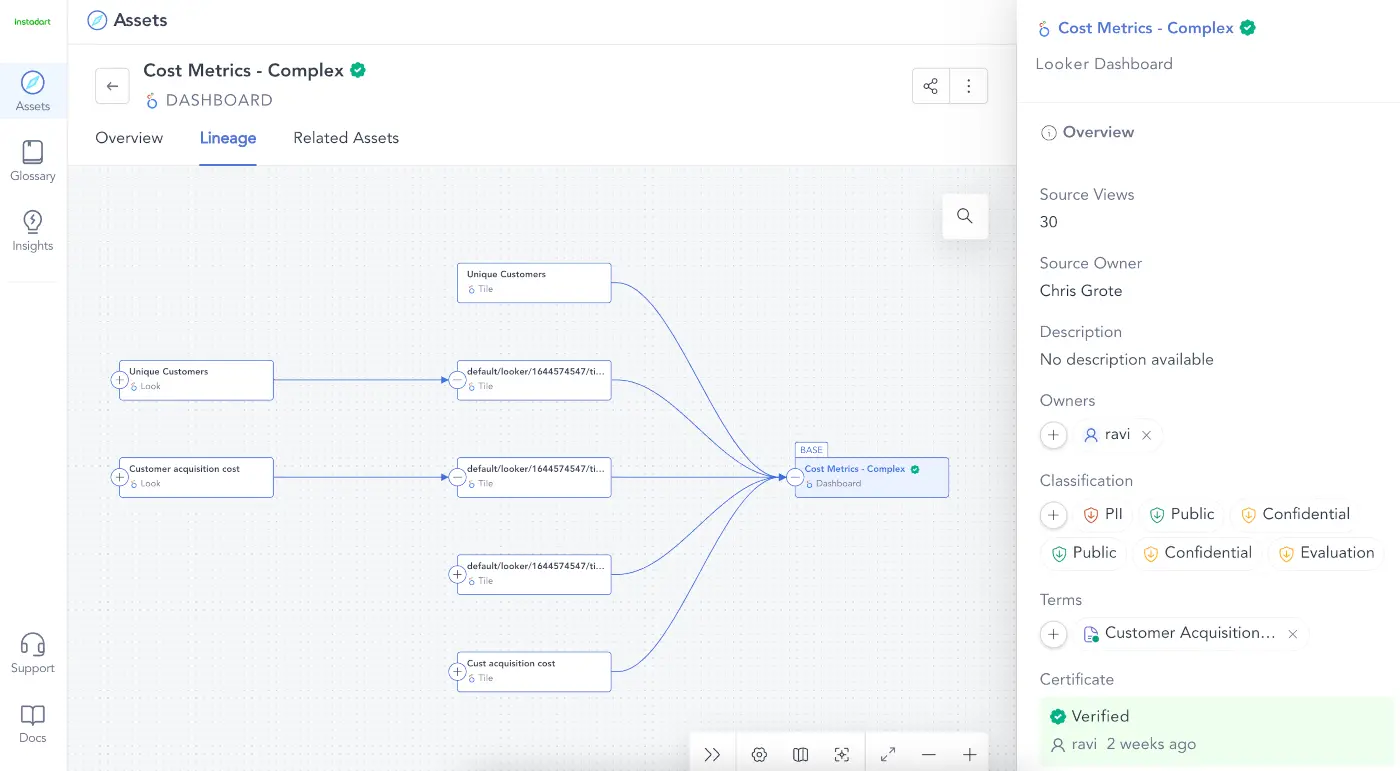
Atlan is a data catalog that connects metadata from data warehouses, BI tools, pipelines, and business applications into a unified enterprise data graph. This graph captures technical and business context, enabling users to discover and understand data assets. Atlan includes AI-assisted documentation and governance workflows.
Key features include:
- Enterprise data graph: Unifies metadata from data platforms, BI tools, and business systems.
- Data discovery and personalized browsing: Allows users to search and browse data assets using metadata-based filters.
- Trust signals for data assets: Provides indicators such as usage activity and verification status.
- AI-assisted metadata enrichment: Generates asset descriptions and links datasets to glossary terms.
- Context pipeline for data knowledge: Combines automated metadata extraction with human review.
6. Amundsen

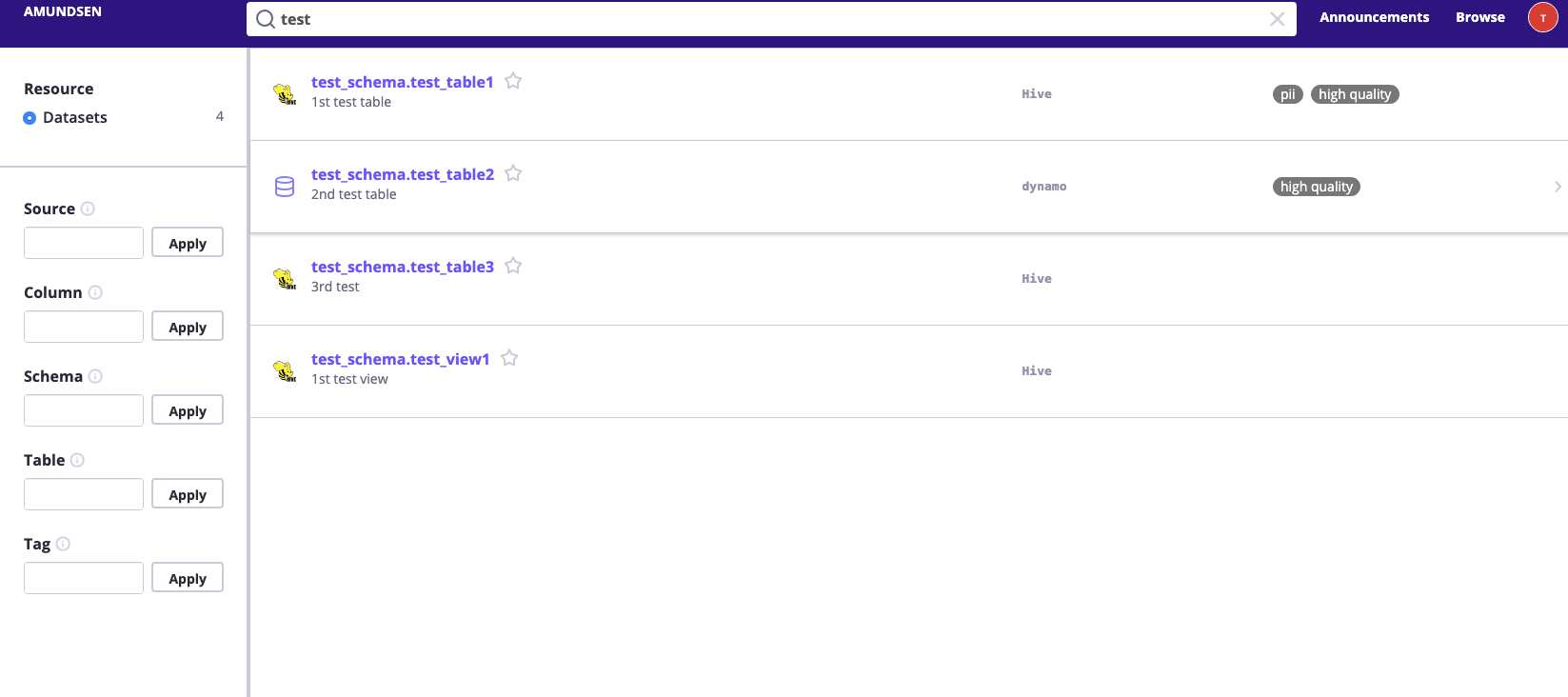
Amundsen is an open source data discovery and metadata platform created at Lyft. It focuses on helping analysts, data scientists, and engineers find and understand datasets and dashboards. Amundsen aggregates metadata from data warehouses, pipelines, and analytics tools to provide searchable context about data assets.
Key features include:
- Data discovery through search: Provides a search interface for datasets, tables, and dashboards.
- Usage-aware ranking: Uses a ranking algorithm based on metadata and query activity.
- Automated and curated metadata: Aggregates table and column descriptions, timestamps, and usage statistics.
- Data lineage and pipeline context: Links datasets to ETL jobs and code that generate them.
- Collaborative metadata editing: Allows users to add or update descriptions for tables and columns.
7. Marquez

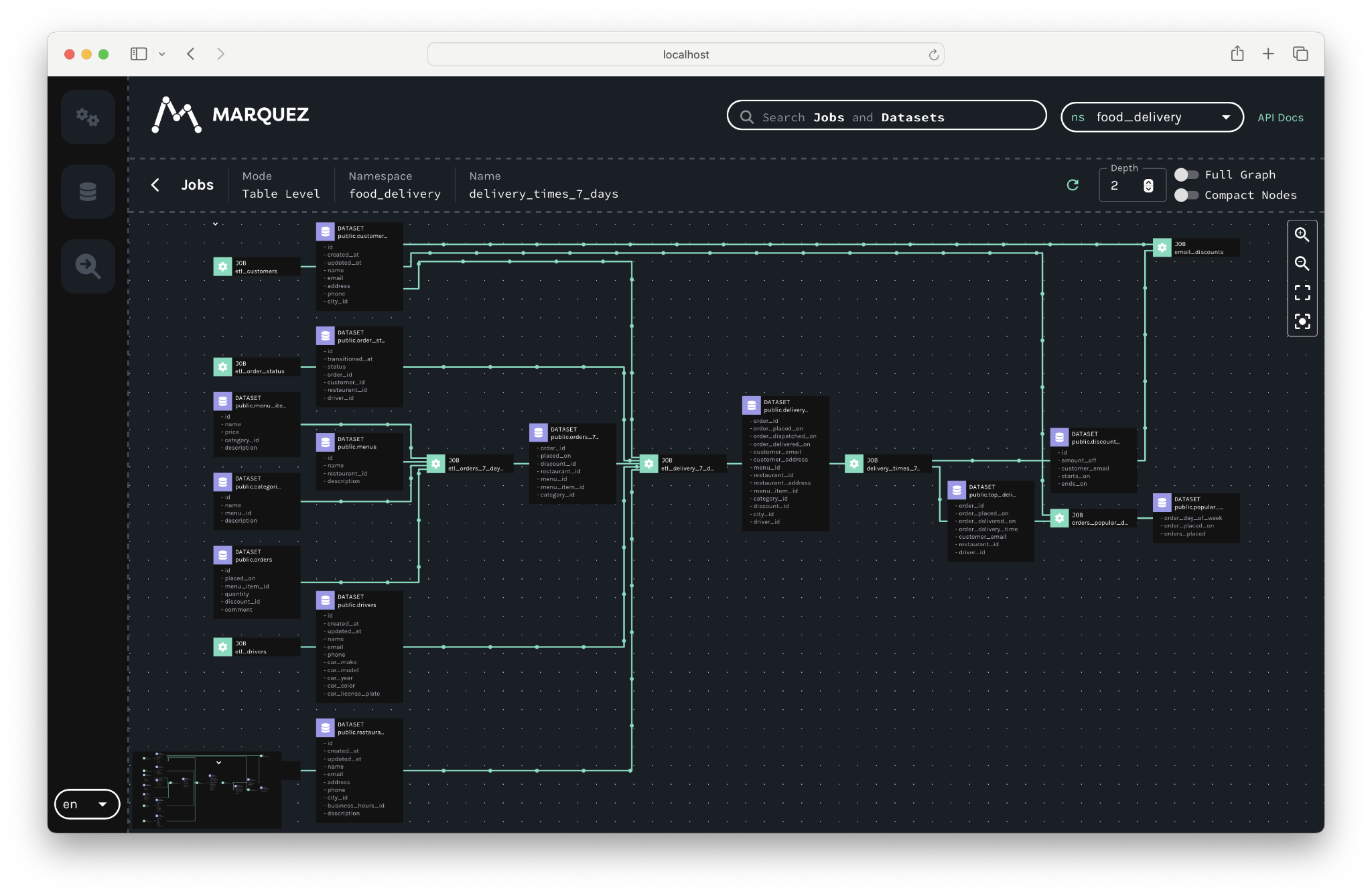
Marquez is an open source metadata service that collects, stores, and visualizes data lineage using the OpenLineage standard. It captures metadata from data pipelines and processing jobs in real time. By aggregating lineage metadata from tools such as Apache Airflow, Apache Spark, and dbt, Marquez provides a view of how datasets are produced and consumed.
Key features include:
- OpenLineage metadata collection: Implements the OpenLineage specification to collect lineage metadata.
- Real-time metadata server: Provides an API endpoint that receives lineage events from running jobs and applications.
- Unified lineage visualization: Displays dataset dependencies, job relationships, and pipeline flows.
- Dataset and job exploration: Allows users to browse inputs, outputs, and execution details.
- Lineage API for automation: Provides APIs to query lineage information programmatically.
Conclusion
Metadata platforms play a critical role in modern data infrastructure by making data assets more discoverable, trustworthy, and governable. They unify metadata from fragmented systems into a centralized source of context, enabling better decision-making, faster troubleshooting, and improved collaboration across teams. As organizations scale their data operations, metadata platforms help maintain control, support compliance, and drive more reliable analytics and machine learning outcomes.