Metadata Management Tools: Buyer's Guide and 6 Solutions to Watch
What Are Metadata Management Tools?
Metadata management tools, including top solutions like OpenMetadata, DataHub, Alation, and Collibra, collect, organize, and govern technical and business data to improve data discovery, lineage tracking, and compliance. These platforms centralize metadata such as schemas, definitions, and ownership to improve data quality and provide a single source of truth, often using AI for automation.
Data teams rely on these tools to document pipelines, track lineage, and debug issues faster. Governance and compliance leads use them to define policies, classify sensitive data, and audit access. AI/ML teams use them to find reliable features, understand data drift, and reproduce experiments. Business users benefit from a shared catalog with clear definitions and ownership, which reduces confusion and duplicate work.
There are two main approaches: passive and active metadata management. Passive tools focus on ingesting and displaying metadata: cataloging assets, visualizing lineage, and enabling search. They improve visibility but rely on users to act on insights. Active metadata management goes further by using metadata to trigger actions. It can enforce policies, alert on data quality issues, auto-tag sensitive fields, and integrate with pipelines to block or fix problems.
In this article:
- Challenges in Metadata Management
- Benefits of Using Metadata Management Tools
- Metadata Management for AI: Context for RAG and Agents
- Core Capabilities of Modern Metadata Management Tools
- How to Choose a Metadata Management Tool
- Notable Metadata Management Tools
Challenges in Metadata Management
Data Silos and Fragmentation
Data silos arise when different departments or systems maintain their own isolated data repositories, making it difficult to access and share information organization-wide. This fragmentation limits collaboration and results in redundant or inconsistent metadata, complicating efforts to establish a single source of truth.
When metadata is scattered across multiple tools, databases, and cloud platforms, organizations struggle to map relationships between data assets, increasing the risk of errors and inefficiencies. Fragmented metadata management also hampers data governance initiatives.
Scaling Metadata Collection
As organizations grow and adopt more data sources, the volume and complexity of metadata increase. Manual approaches to collecting metadata become unsustainable, especially in environments with hundreds or thousands of data assets. Automated metadata harvesting tools help, but they must handle diverse data types and evolving schemas.
Ensuring that these tools scale with the organization's needs is a significant challenge. Another aspect of scaling metadata collection is accommodating both structured and unstructured data across on-premises and cloud environments. The ability to integrate with a wide variety of data platforms, from data warehouses to data lakes and SaaS applications, is critical.
Keeping Metadata Up-to-Date
Maintaining accurate and current metadata is a continuous challenge as data assets are created, modified, or deprecated. Changes in data schemas, business definitions, or access controls require corresponding updates to metadata, or the information becomes stale. Outdated metadata can mislead users, lead to incorrect analyses, and undermine trust in the data catalog.
Automating metadata updates is important, but automation alone is not enough. Organizations need processes to monitor changes, trigger updates, and validate the accuracy of metadata across systems. This often involves integrating metadata management tools with data pipelines, workflow automation, and data governance frameworks.
Providing Context for AI and Agents
AI systems and autonomous agents rely on high-quality context to interpret data correctly and produce reliable outputs. Metadata management tools supply this context by defining data meaning, relationships, and usage constraints. For example, business glossaries clarify ambiguous terms, while lineage data shows how datasets are derived. This reduces the risk of AI models misinterpreting fields or using the wrong data sources.
Metadata also helps agents operate safely and efficiently across systems. Access policies, data classifications, and ownership details guide agents on what data they can use and how. Without this layer, AI systems may violate governance rules or produce inconsistent results. Centralized metadata ensures that both humans and machines follow the same definitions and rules.
As organizations adopt retrieval-augmented generation (RAG) and agent-based workflows, metadata becomes part of the runtime context. Tools can enrich queries with schema details, filter results based on data quality, and provide lineage for traceability.
Benefits of Using Metadata Management Tools
Metadata management tools address operational and governance challenges that come with growing data environments. They provide structure and visibility, making it easier for teams to find, trust, and use data:
- Improved data discovery: Centralized metadata catalogs make it easier for users to find relevant data assets. Search, tagging, and classification reduce time spent looking for data and increase reuse.
- Stronger data governance: These tools enforce consistent policies for data ownership, access, and usage.
- Better data quality: Metadata provides context about data sources, transformations, and usage.
- End-to-end data lineage: Tracking how data moves across systems helps users understand dependencies and impacts.
- Reduced data silos: By integrating metadata across systems, these tools create a unified view of the data landscape.
- Operational efficiency: Automation of metadata collection and updates reduces manual effort.
- Enhanced decision-making: With clear, reliable metadata, both technical and business users can make informed decisions faster.
Metadata Management for AI: Context for RAG and Agents
How AI Agents and LLMs Need Metadata to Operate on Enterprise Data
AI agents and LLMs do not understand enterprise data by default. They need metadata to interpret schemas, field meanings, and relationships between datasets. Without this context, a model may confuse similar fields, join the wrong tables, or misinterpret units and formats. Metadata such as column descriptions, data types, and business definitions guides models toward correct usage.
Lineage and usage metadata also help AI systems choose reliable sources. For example, an agent can prioritize curated datasets over raw ingestion tables or avoid deprecated assets. Access and classification metadata ensure the model respects permissions and sensitive data boundaries. This is critical when agents generate queries or retrieve data automatically.
Metadata is injected into prompts or retrieval steps. Systems enrich user queries with schema details, synonyms from glossaries, and constraints. This improves query generation, reduces hallucinations, and increases the accuracy of results returned by RAG pipelines.
Why Metadata Management Tools Are Becoming the AI Context Layer
Metadata platforms are evolving into the context layer that sits between AI systems and data infrastructure. They centralize schemas, definitions, lineage, quality signals, and policies in a form that can be queried at runtime. Instead of hardcoding data knowledge into prompts or applications, teams can fetch context dynamically from the metadata store.
This approach scales better as data environments change. When schemas evolve or new datasets are added, updates are reflected in the metadata layer without retraining models or rewriting prompts. It also standardizes how different agents access and interpret data, reducing inconsistencies across applications.
Vendors are adding APIs, embeddings, and semantic search over metadata. This allows agents to retrieve relevant tables, columns, and documentation based on intent, not just exact names. As a result, metadata tools become a control plane for how AI interacts with enterprise data.
MCP and Programmatic Access for Agents
Model Context Protocol (MCP) and similar patterns define how agents request and receive structured context from external systems. Metadata management tools can expose MCP-compatible endpoints or APIs that return schemas, lineage, and policies in a machine-readable format. This enables agents to fetch the exact context they need during execution.
Programmatic access is key for automation. Agents can discover datasets, validate query plans against schemas, and check permissions before execution. They can also log lineage for actions they take, feeding back into the metadata system for auditability.
This shifts metadata from a passive catalog to an active service. Instead of users browsing a UI, agents integrate directly with metadata APIs to guide decisions in real time. The result is safer and more reliable automation across data workflows.
Brief Connection to Ontologies and Semantic Models
Ontologies and semantic models add a layer of meaning on top of raw metadata. They define entities, relationships, and standardized vocabularies across the organization. This helps align technical schemas with business concepts, such as mapping multiple tables to a single “customer” entity.
For AI systems, semantic layers reduce ambiguity. An agent can reason over business terms instead of raw table structures, improving query generation and interpretation. They also enable cross-system joins by defining consistent relationships.
Metadata management tools increasingly integrate with or generate semantic models. Together, they provide both the structural metadata (schemas, lineage) and the conceptual layer (entities, relationships) needed for accurate and explainable AI-driven data access.
Core Capabilities of Modern Metadata Management Tools
Metadata Ingestion and Integration
Modern metadata management tools offer automated ingestion capabilities that extract metadata from a wide variety of sources, including databases, data lakes, cloud platforms, ETL pipelines, and business intelligence tools. By connecting to these sources, the tools can continuously collect technical, operational, and business metadata.
Integration features allow metadata from different systems to be consolidated and standardized. This often involves mapping metadata formats, resolving conflicts, and enriching metadata with additional context. Effective ingestion and integration ensure that metadata is captured, organized, and made accessible for processes such as discovery, governance, and analytics.
Unified Metadata Repository / Graph
A unified metadata repository serves as the central hub for all metadata assets, offering a single source of truth for data governance and analytics. Some tools use graph-based models to represent relationships between data assets, such as lineage, dependencies, and business terms. This graph structure enables users to visualize how data flows across systems and how different assets are connected.
The unified repository improves accessibility and control. Users can search, query, and analyze metadata efficiently, while administrators can enforce consistent policies and monitor compliance. By centralizing metadata, organizations reduce duplication, enhance data quality, and simplify management, regardless of the diversity or scale of their data environments.
Data Discovery and Cataloging
Data discovery features enable users to search, browse, and understand data assets across the organization. Cataloging capabilities automatically index metadata, classify data types, and group related assets, making it easier for users to find what they need. This self-service approach reduces reliance on IT teams and supports a data-driven culture.
Cataloging also involves enriching metadata with business context, such as ownership, usage metrics, and data classifications. This contextual information helps users assess data relevance, sensitivity, and quality, leading to informed decision-making. Effective discovery and cataloging support enterprise data use and compliance initiatives.
Data Lineage and Impact Analysis
Data lineage capabilities provide a visual and detailed record of how data moves and transforms across systems, from source to consumption. By tracking data flows, lineage tools help users understand dependencies, trace errors, and identify the origins of specific data points. This transparency supports debugging, auditing, and regulatory compliance.
Impact analysis extends lineage by assessing the downstream effects of changes to data assets, such as schema modifications or data deletions. By simulating these changes, organizations can anticipate potential disruptions and mitigate risks before they occur.
Data Quality and Observability
Data quality features in metadata management tools monitor and validate the accuracy, completeness, and consistency of data assets. Automated checks can detect anomalies, missing values, or schema mismatches, alerting teams to potential issues. By linking data quality metrics to metadata, organizations can prioritize remediation efforts and maintain standards across the data ecosystem.
Observability provides continuous visibility into the health and performance of data pipelines. This includes tracking data freshness, monitoring access patterns, and detecting unusual activity. Data quality and observability capabilities support reliable data platforms for analytics, reporting, and compliance.
How to Choose a Metadata Management Tool
Selection Criteria
Choosing a metadata management tool depends on how well it fits your data stack, governance needs, and scale. Focus on capabilities that reduce manual work and integrate cleanly with existing systems:
- Integration coverage: The tool should connect to your core systems - data warehouses, lakes, ETL tools, BI platforms, and SaaS apps. Broad native connectors reduce custom work and ensure consistent metadata ingestion.
- Automation and scalability: Look for automated metadata harvesting, lineage extraction, and classification. The system should handle growth in data volume, users, and assets without performance issues.
- Metadata model and extensibility: A flexible schema or graph model allows you to represent technical, business, and operational metadata together. Support for custom fields, tags, and APIs is important for adapting to internal needs.
- Search and discovery experience: Strong search, filtering, and ranking capabilities improve usability. Features like semantic search, synonyms, and usage-based ranking help users find relevant data quickly.
- Governance and policy enforcement: Evaluate how the tool handles ownership, access controls, classifications, and policy workflows. It should integrate with identity systems and support auditability.
- Lineage depth and accuracy: Ensure the tool can capture end-to-end lineage across pipelines and transformations. Column-level lineage is often necessary for debugging and compliance.
- Data quality and observability integration: Native or integrated data quality checks help link metadata with actual data health. This improves trust and prioritization of issues.
- AI and API capabilities: APIs, embeddings, and support for programmatic access (e.g., MCP patterns) are important if you plan to use AI agents or RAG systems. The tool should act as a context provider at runtime.
- Deployment model and security: Consider SaaS vs. self-hosted options, data residency, and compliance requirements. Security features should align with your organization’s policies.
- Total cost of ownership: Include licensing, implementation, and maintenance costs. Tools that require heavy customization or manual upkeep can become expensive over time.
Common Buyer Questions
Buyers often evaluate metadata tools by how quickly they deliver value and how well they fit into existing workflows. These questions help clarify trade-offs:
- How long does implementation take?
Time depends on integration complexity and governance maturity. Initial catalogs can be set up quickly, but full adoption (lineage, governance workflows) takes longer. - How much manual effort is required?
Buyers want to know how much metadata is auto-ingested vs. manually curated. High automation reduces long-term operational cost. - Does it support our existing data stack?
Compatibility with current tools is critical. Gaps in connectors may require custom integration work. - How accurate and complete is lineage?
Not all tools provide the same depth. Buyers often ask about column-level lineage and support for complex transformations. - Can business users actually use it?
Usability matters. Non-technical users should be able to search, understand, and trust the data without relying on data engineers. - How does it handle governance and compliance?
Questions focus on policy enforcement, audit logs, and support for regulations like GDPR or HIPAA. - What are the API and automation capabilities?
Teams want to integrate metadata into pipelines, CI/CD, and AI systems. Strong APIs are a key requirement. - How does it support AI use cases?
Increasingly, buyers ask how the tool provides context for LLMs, supports RAG pipelines, or integrates with agent workflows. - What happens as our data grows?
Scalability in terms of assets, queries, and users is a common concern. Performance and cost at scale are key factors. - What is the pricing model?
Pricing may depend on the number of assets, users, or compute usage. Buyers need clarity to avoid unexpected costs.
Notable Metadata Management Tools
Open Source Metadata Tools
1. OpenMetadata
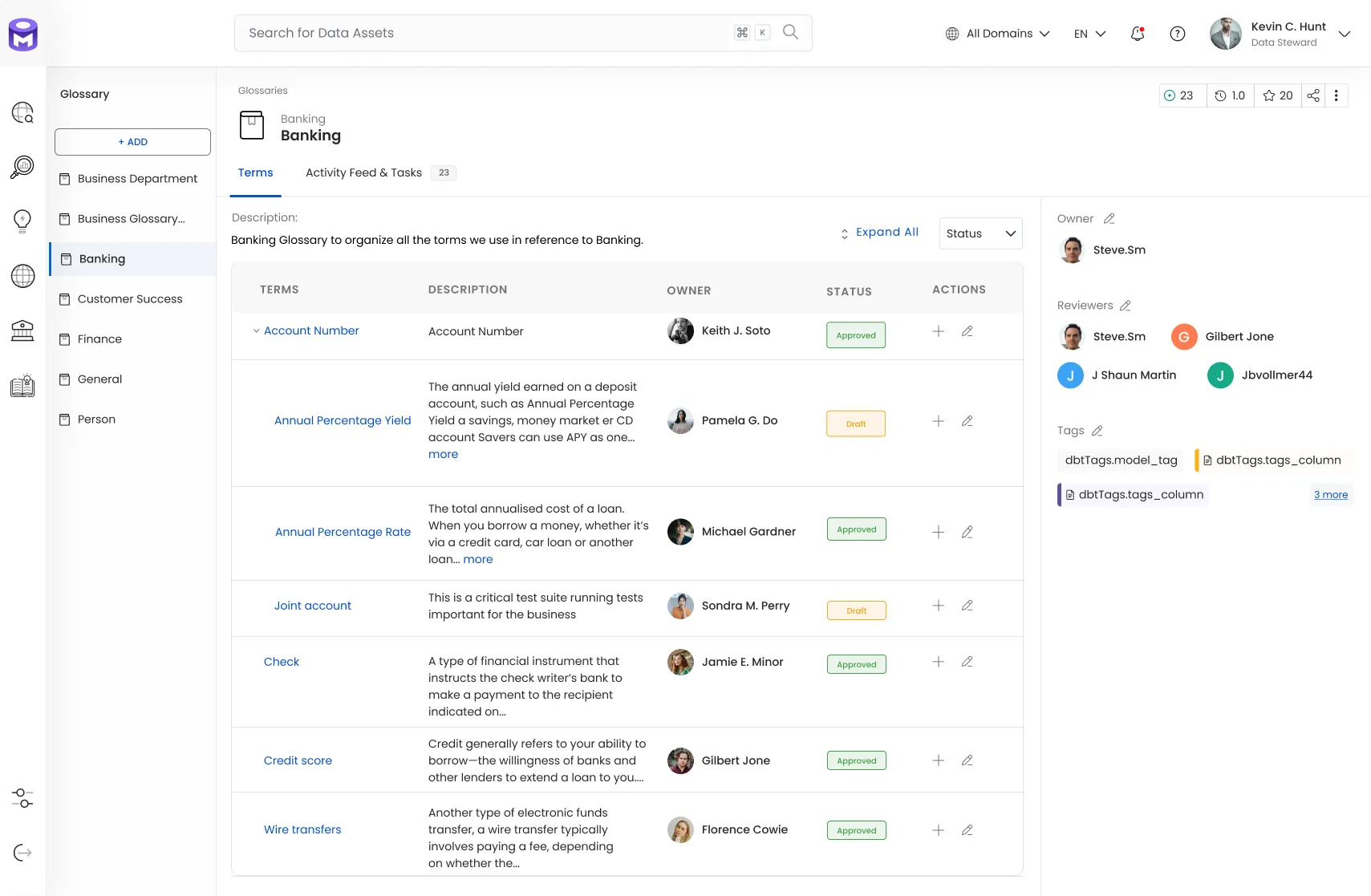
OpenMetadata is an open-source metadata platform and AI context layer that unifies technical and business metadata into a single, queryable knowledge graph. It uses a formal ontology and 130+ native connectors to address fragmentation across modern data stacks, giving teams one place to discover, govern, and trust their data.
Key features include:
- Open metadata standard: Defines a formal schema for tables, dashboards, ML models, lineage, and ownership, with W3C support including MCP, RDF, DCAT, DPROD, ODCS, and OpenLineage, so vendors and downstream tools implement a common ontology consistently.
- 130+ native connectors: Ships with connectors for databases, warehouses, BI tools, pipelines, and ML systems that ingest schema, lineage, ownership, and usage without custom code.
- Built-in quality and observability: Test suites, profilers, and incident workflows run alongside catalog functions, so quality and freshness are part of the same metadata graph.
- Column-level lineage: Captures lineage from SQL queries, ETL pipelines, and orchestrators at column-level granularity for impact analysis and debugging.
- Apache 2.0 licensed: Fully open source with an active community contributing connectors, schemas, and integrations across hundreds of platforms.
2. DataHub
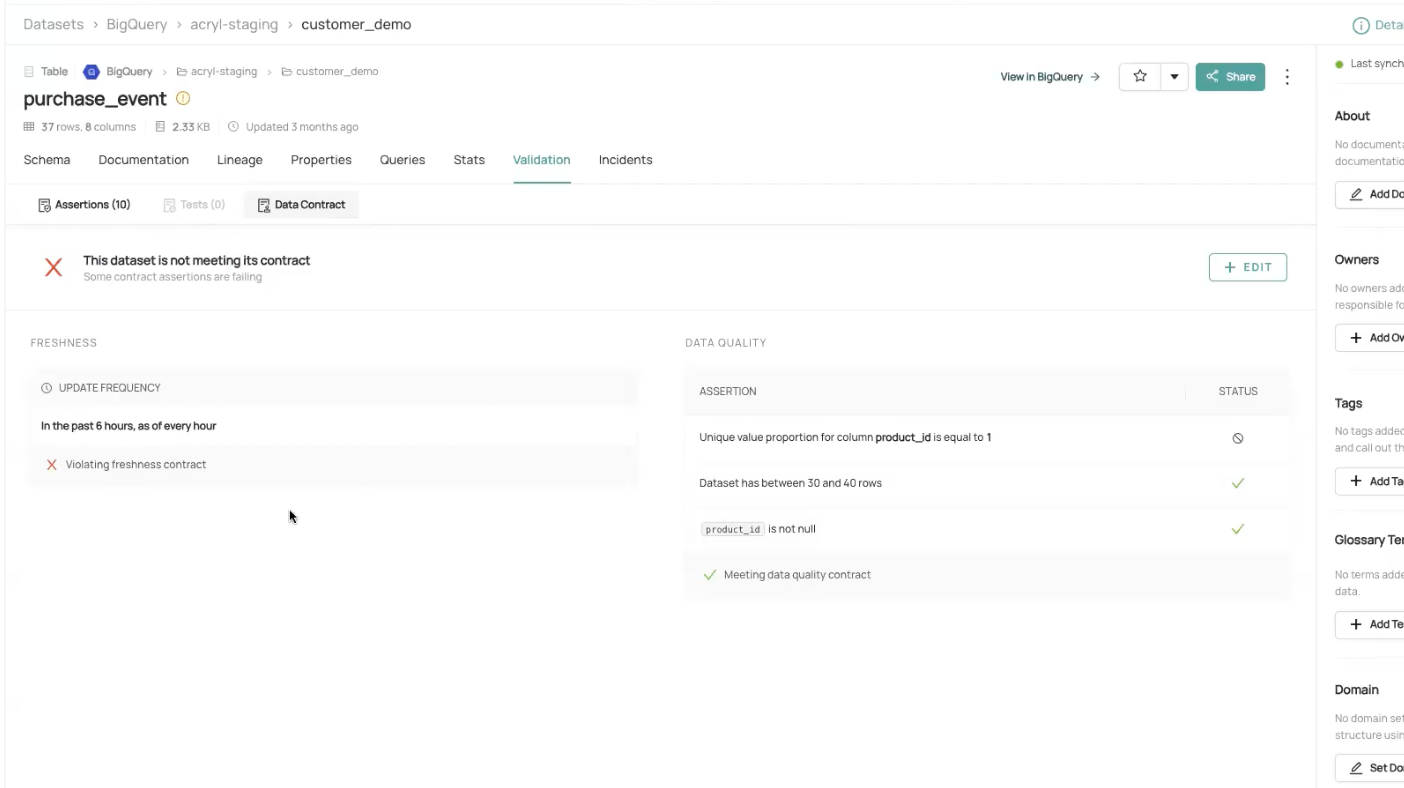
DataHub is an open-source metadata management platform that serves as a central layer for connecting, organizing, and governing metadata across modern data stacks. It addresses fragmentation by integrating metadata from multiple systems into a unified, continuously updated graph. This allows teams to understand how data assets relate to each other, track lineage, and enforce governance policies.
Key features include:
- Unified metadata graph: Builds a graph-based model that captures relationships between datasets, pipelines, dashboards, and users.
- Real-time and batch metadata ingestion: Supports streaming and batch ingestion models to collect metadata from connected systems.
- Extensive connector ecosystem: Provides over 80 production-ready connectors for systems like data warehouses, BI tools, and pipelines.
- Advanced data discovery: Includes a universal search capability to locate datasets, dashboards, or other assets across connected platforms.
- Fine-grained data lineage: Tracks data flow at a detailed level, including column-level lineage.
3. Apache Atlas
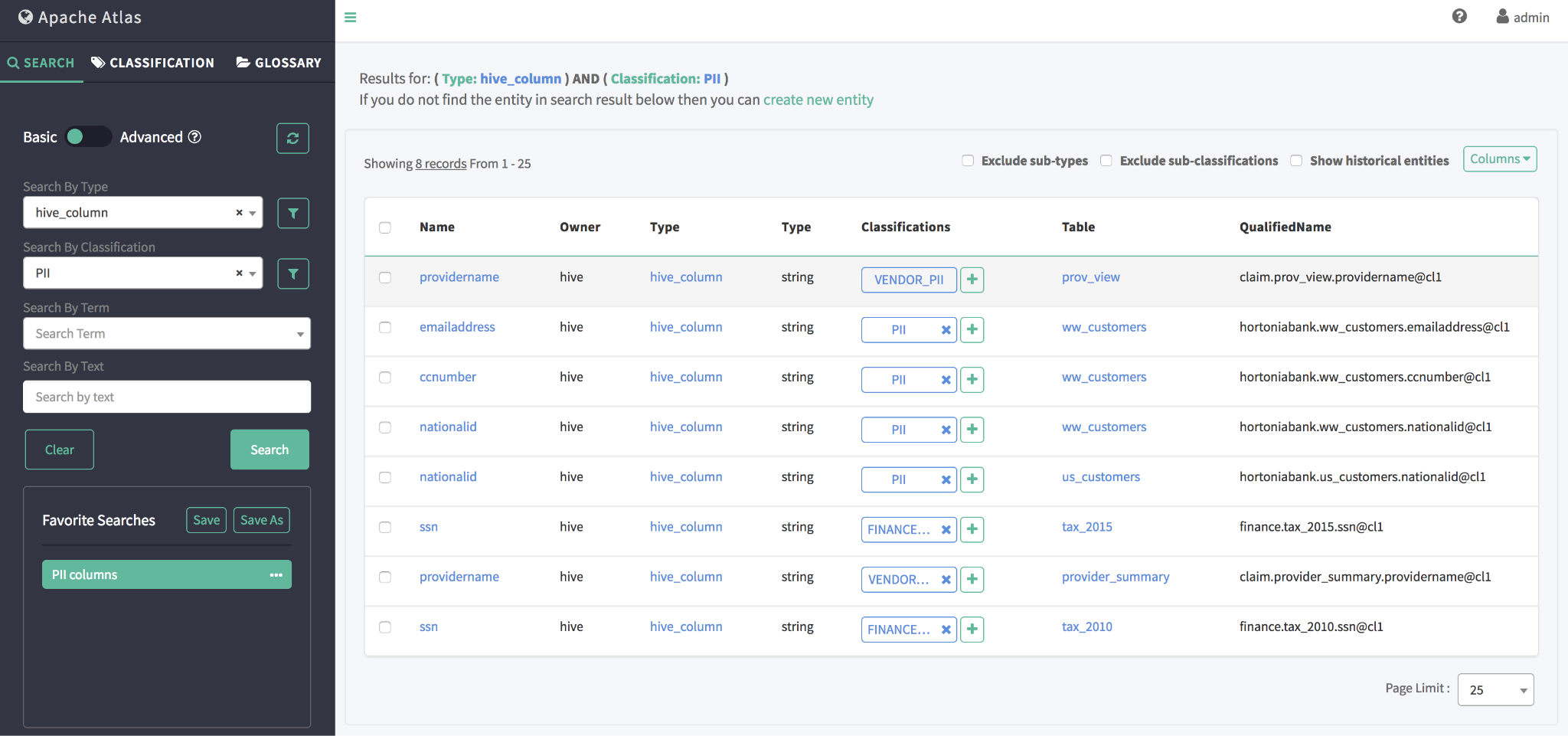
Apache Atlas is an open-source metadata management and governance platform that helps organizations manage data assets across Hadoop and enterprise ecosystems. It provides a scalable and extensible framework for building a centralized metadata catalog, defining data classifications, and enforcing governance policies.
Key features include:
- Extensible metadata model: Supports predefined metadata types for Hadoop and non-Hadoop systems, while allowing users to define custom types.
- Metadata entities and relationships: Represents real-world data objects as entities, capturing metadata and relationships between them.
- Comprehensive REST APIs: Provides APIs to create, manage, and query metadata types and entities.
- Dynamic data classification: Allows creation of custom classifications such as PII, sensitive data, or data quality tags.
- Classification propagation: Automatically propagates classifications through data lineage.
Enterprise Metadata Tools
4. Collate

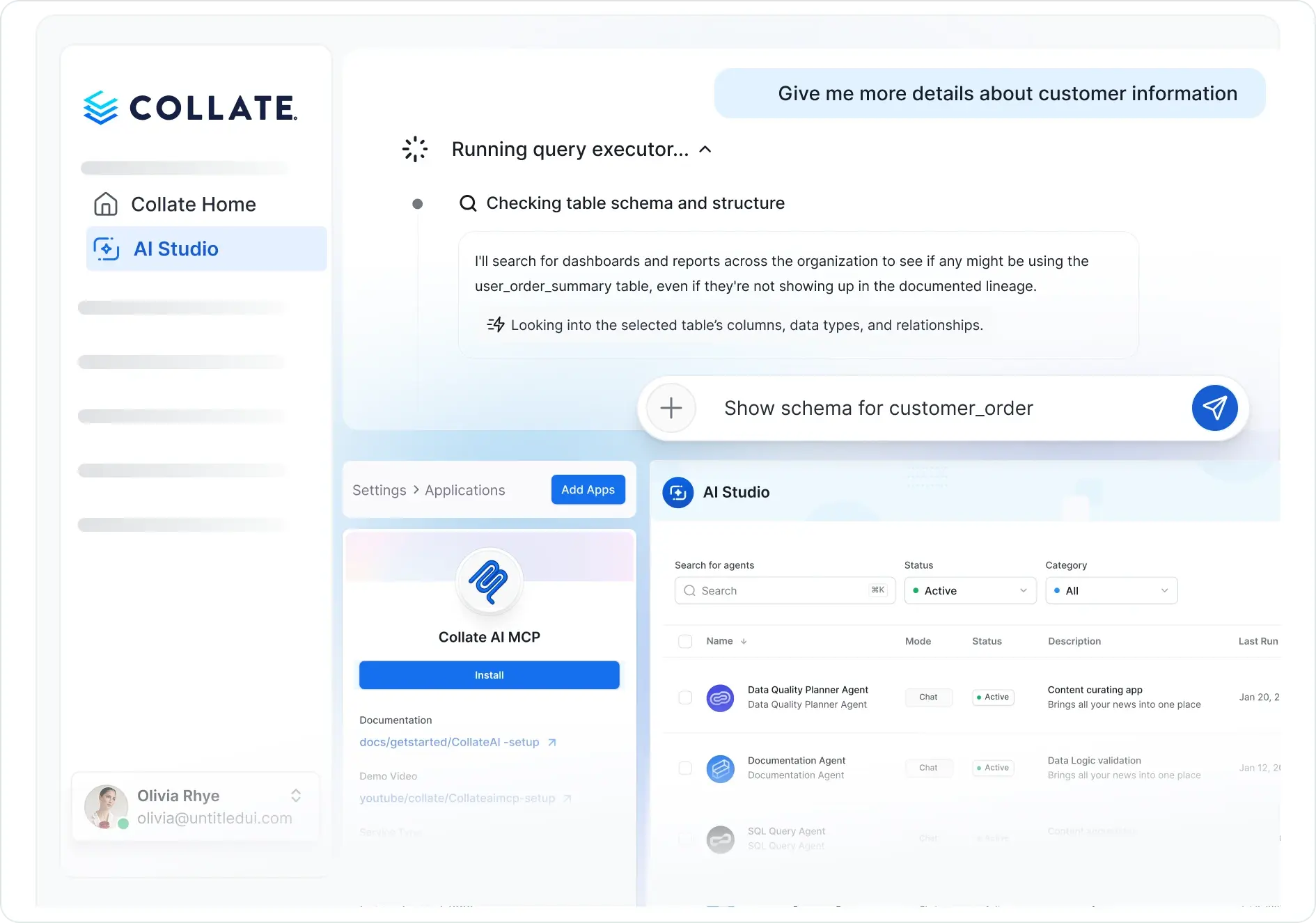
Collate is the AI for Data platform built on OpenMetadata. It extends the open metadata standard with managed deployment, enterprise governance, conversational AI, code & no code agents, and an AI native experience.
Key features include:
- Built on OpenMetadata: Inherits the open standard, 130+ connectors, and ontology of OpenMetadata while adding managed hosting, SSO, RBAC, and enterprise SLAs.
- Collate AI conversational interface: Users ask natural-language questions in web, Slack, or Teams and get governed, sourced answers grounded in their own data.
- Data marketplace and data products: Collate exposes trusted data products through a marketplace UI so business users self-serve, with integrated data access request workflows.
- AI agents ecosystem: Pre-built agents and a no-code AI Studio automate documentation, tiering, classification, and data quality at scale, with an AI SDK for custom AI applications.
- Memory, skills, and automations: Every approval, tag, and steward decision is captured as a permanent, attributable record that feeds back into governance reporting and agent learning.
5. Alation Metadata Management

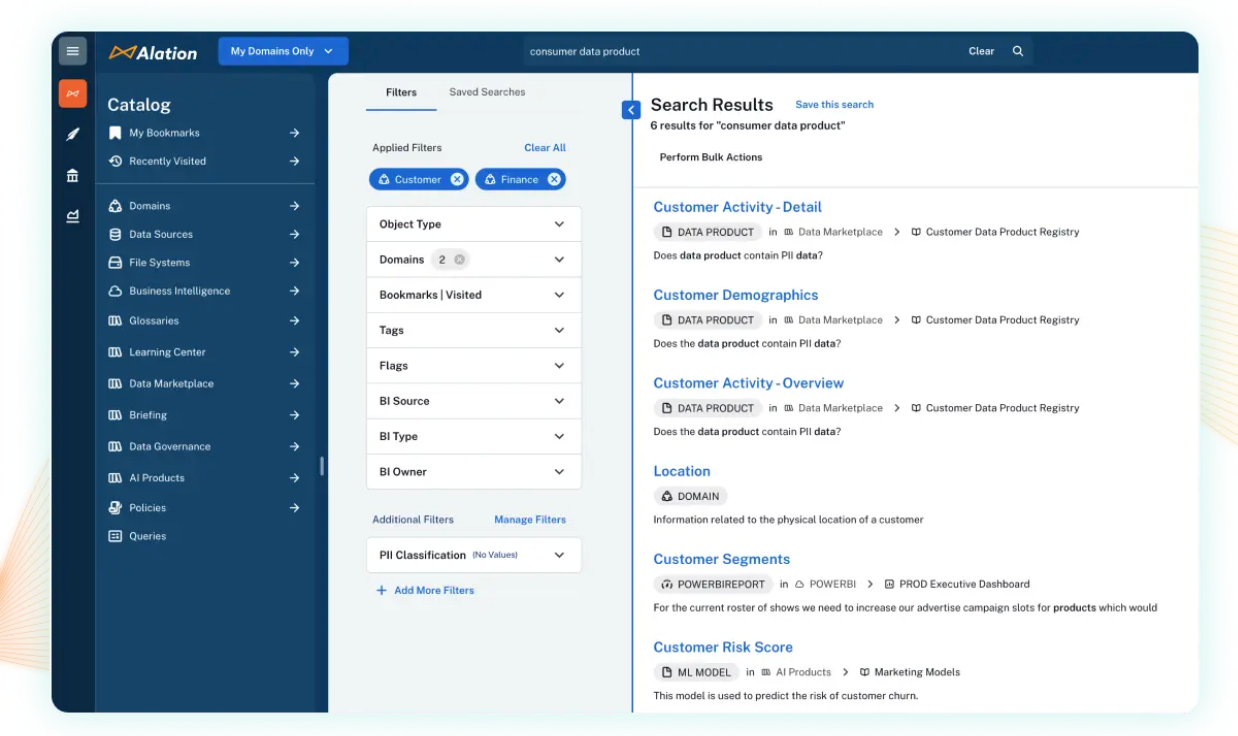
Alation Metadata Management is a platform that activates and operationalizes metadata across an organization’s data ecosystem. It enriches metadata with behavioral insights, allowing teams to understand how data is used and accessed. By connecting metadata from multiple sources and aligning it with a central business glossary, Alation helps organizations support analytics, governance, and decision-making.
Key features include:
- Active metadata and data fabric integration: Connects and enriches metadata from various data sources and aligns technical metadata with a central business glossary.
- Behavioral metadata analysis: Uses a Behavioral Analysis Engine to capture usage patterns such as data popularity, search relevance, and access trends.
- Embedded metadata in workflows: Surfaces metadata within tools like Slack, Microsoft Teams, and Tableau.
- Improved data discovery and trust: Provides an interface to search and evaluate data assets.
- End-to-end data lineage: Tracks how data moves and transforms across systems over time.
6. Collibra Data Catalog
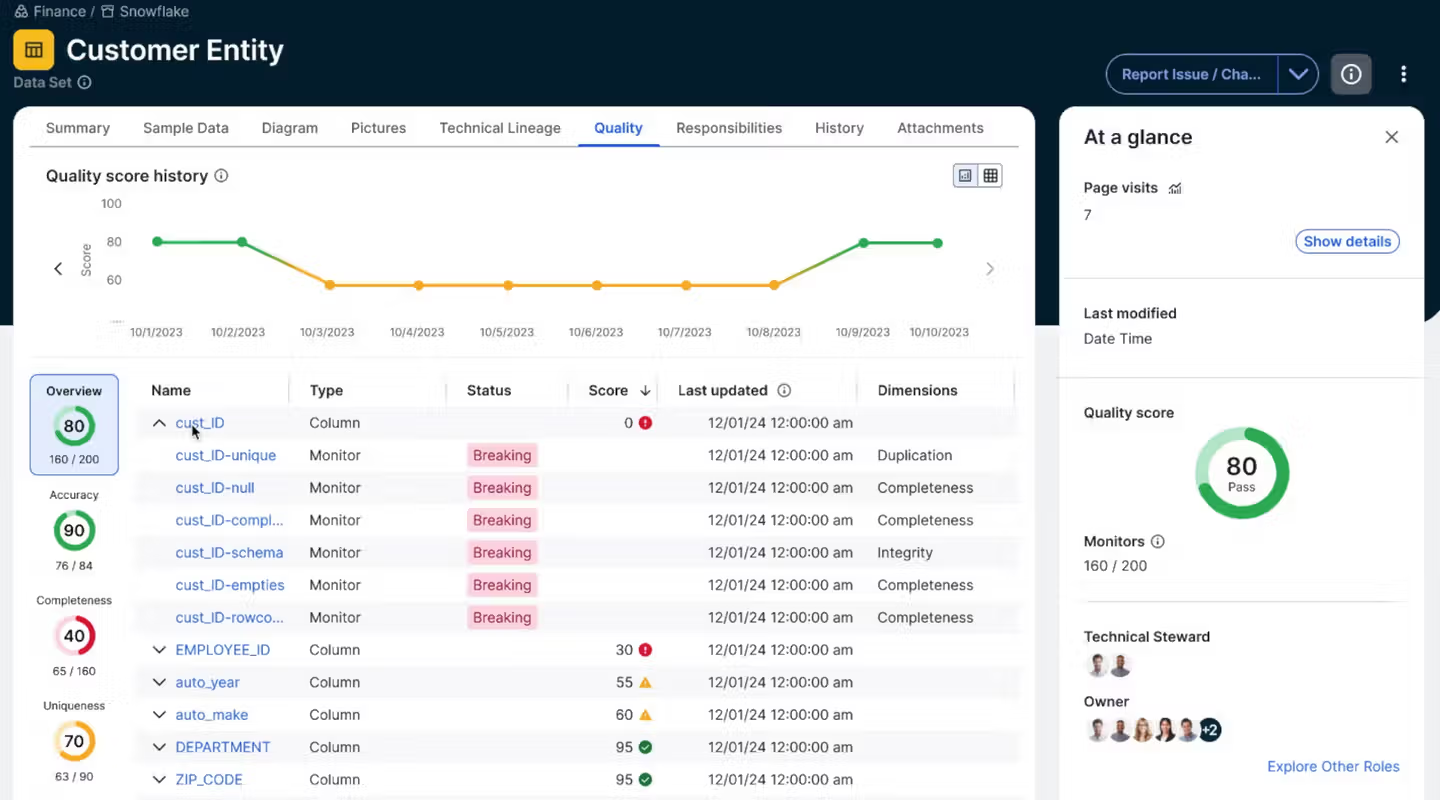
Collibra Data Catalog is a metadata management platform that helps organizations build a centralized and trusted view of their data landscape. It focuses on improving data clarity, consistency, and accessibility by combining automated metadata curation, business context, and governance signals.
Key features include:
- Centralized data inventory: Creates a unified view of data assets across the organization.
- Broad data source integration: Connects to over 100 data sources, including cloud platforms, databases, BI tools, enterprise applications, and legacy systems.
- Automated data discovery and classification: Uses automated classification to label data, including sensitive types like PII and PHI.
- Data profiling and insight generation: Provides visibility into data structure and patterns through profiling statistics and data samples.
- Automated curation and enrichment: Automatically generates descriptions and enriches metadata with context.
Conclusion
Metadata management tools are crucial in data systems, organizing context around data and making it usable at scale. They reduce the effort required to discover, understand, and govern data while improving consistency across teams. As data environments grow and AI systems become more integrated into workflows, metadata shifts from a passive catalog to an active layer that informs decisions, enforces policies, and supports automation.